Research

Relativistic Compact Objects

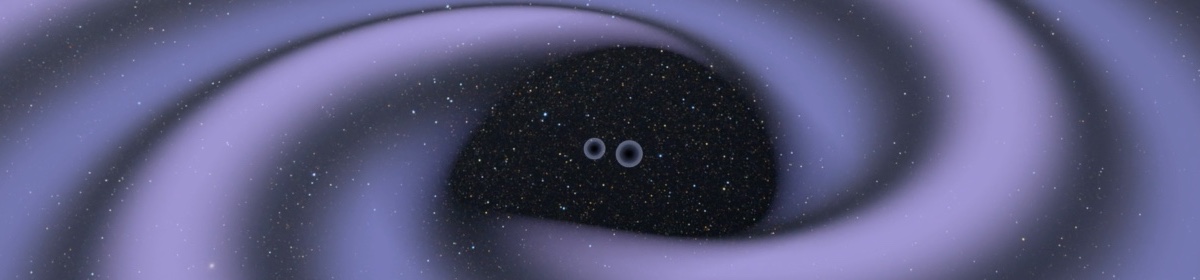
Despite the simple dynamics of the two-body problem in Newtonian gravity, the relativistic problem is notoriously difficult. Gravitational radiation gradually removes energy and angular momentum from the system, driving the objects to inspiral together until they merge. The predictions of Einstein’s quadrupole formula were confirmed with the 1974 Nobel-prize observation of radiative decay in the Hulse-Taylor binary pulsar. In 2015, the first direct GW observations by LIGO allowed us to probe strong-field, highly dynamical processes from black hole mergers, and neutron star merger observations are expected next. Because the detector’s output contains noise greater than the signal itself, match-filtering is typically necessary, which requires a priory theoretical knowledge of the gravitational-wave signal. Accurate waveform templates are essential for the identification and physical interpretation of their sources, and considerable effort has been made to model the two-body dynamics in the strong-field regime of general relativity. Although analytical techniques, based on perturbative approximations, have been very successful in modelling early inspiral, their limit of applicability is reached when strong-field nonlinear effects appear. Numerical relativity thus becomes crucial for modelling the system through late inspiral, plunge, merger and beyond and calculating the resulting waveforms.

Efforts to obtain numerical solutions for black hole binaries date back to the 1960s and 1970s. NCSA was founded in 1976 by Larry Smarr, motivated by the problem of simulating a binary black hole collision. The Cactus code (E. Seidel, G. Allen et al., AEI, NCSA, Cardiff, LSU) targeted systematized the effort towards solving this problem since 1998. These efforts started to pay off in 2001 (M. Alcubierre, B. Brügmann, E. Seidel et al. 3D Grazing Collision of Two Black Holes, PRL 87 27) and were followed in 2005 by the breakthrough of F. Pretorius (Evolution of Binary Black-Hole Spacetimes, PRL 95), whence the first successful simulations were performed, initiating an era of rapid developments in numerical relativity and the theoretical discovery of several unexpected strong-field phenomena.

Projects


Numerical Relativity

Numerical relativity is a field of physics that uses numerical methods to solve Einstein’s equations of general relativity or other field equations governing relativistic gravity. Numerical relativity is used to model and understand astrophysical systems such as the collisions of black holes and neutron stars, the generation and dynamics of gravitational waves, supernovae explosions, and cosmological spacetimes.

The complexity of Einstein’s Equations, and the need to simulate 3D spacetimes, has meant that the numerical relativity community has needed to develop a large amount of scientific software, which is usually run of supercomputers. This has led to numerical relativity being a driver for supercomputers and modern cyberinfrastructure.

The NCSA Gravity Group develop and use the Einstein Toolkit, based on the Cactus Framework, to model black hole, neutron star and boson star binary systems, and the GAMER code for cosmological spacetimes. We are part of the NSF Blue Waters and XSEDE projects which provide computational resources and support for our work.

Projects


Deep Learning

Deep learning, i.e, machine learning based on deep artificial neural networks, is one of the fastest growing fields of artificial intelligence research today, having outperformed competing methods in many areas of machine learning applications, e.g., image classification, face detection/recognition, natural language understanding and translation, speech recognition and synthesis, personal assistants (Siri, Google Now, Cortana), game-playing (e.g., Go, Poker), medical diagnosis, and self-driving vehicles. These deep artificial neural networks are able to capture complex nonlinear relationships using hierarchical internal representations which are learned automatically from the training data.

In the NCSA Gravity Group, we are applying deep learning with artificial neural networks, in combination with HPC numerical relativity simulations, in a variety of multimessenger astrophysics applications. Our current focus is on signal processing for gravitational wave detectors (LIGO, VIRGO, NANOGrav), analyzing data from telescopes (DES, LSST), and modeling waveforms from gravitational wave sources using algorithms that learn from numerical relativity simulations. This allows for real-time detection and parameter estimation of gravitational wave signals in LIGO, for denoising LIGO data contaminated with non-Gaussian noise, and for classification and unsupervised clustering of glitches (anomalies) in the LIGO detectors. We are now also developing fast automated transient search algorithms based on deep learning using raw image data from telescopes (e.g., DES and LSST) to rapidly classify electromagnetic counterparts to gravitational wave events.

Projects


Scientific Computing & Cyberinfrastructure

Einstein’s equations are some of the most complicated and demanding equations in physics, and solving them numerically for astrophysical systems has required the use of supercomputers and motivated the development of new algorithms and new computing methodologies.

Projects

Gravity Group
1205 W. Clark St.
Urbana, Illinois 61801
Email: kindrtnk@illinois.edu
CookieSettings CookieSettings